
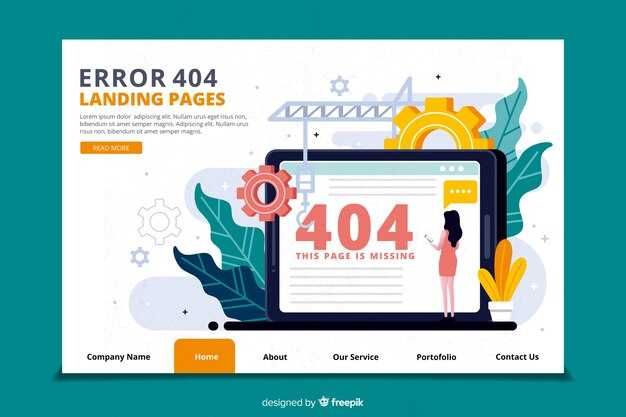
Implement a crisp 404 page that guides users to the main sections of your site. For websites with catalogs or applications running multiple modules, a helpful 404 reduces bounce and youve kept engagement on the site. Use real-world data from your logs and queries to tailor the response, and build a habit of reviewing 404s as part of development sprints. A well-designed page also reinforces decision-making by offering direct paths to popular actions and recent content itself.
404s stem from broken links, moved pages, or user typos. Track sources via server logs and queries; fix with 301 redirects for moved content, 410 for permanently removed pages, and keep sitemaps updated. On mid-size websites, 404 sessions account for about 0.5–2% of total visits; applying automated link checks and redirects can reduce that share by 40–60% within a quarter, with uplift in conversions on affected pages by 5–15%.
Best practices include offering a concise message, a search field, and quick links to top categories. Provide a link back home, a small sitemap, and a set of suggested actions. Create a series of updates and tests, and occasionally host webinars to train teams on interpreting 404 data and adjusting content. Ensure the page is accessible across development environments and that you log 404 events for decision-making. Add a generative hint system to offer content suggestions based on user intent and site context.
Align 404 handling with the broader lifecycle of your product. Implement a shared 404 middleware across applications to ensure uniform behavior; log each event with the originating queries, referrer, and user context itself. Set a target to reduce failed requests by a defined amount within 90 days; run A/B tests comparing a default 404 page versus a helpful variant. Use a learning approach and a series of webinars to train teams on turning 404 insights into content and structural improvements.
Implementation steps you can apply now: audit your top pages and links, enable 301/410 responses where appropriate, add a search box and prominent links on every 404, integrate with analytics to track metrics, and plan a quarterly learning series with webinars to review results and adjust content. This approach helps you achieve tangible outcomes across teams and websites and applications.
404 Error Page Not Found: Practical Guidance for Developers and AI Engineers
Implement a user-friendly 404 page that explains the issue in clear terms and offers immediate next steps: a search field, a link to the homepage, and a compact sitemap. This setup helps visitors find content faster.
Log 404 events with URL, referrer, timestamp, and user context; analyze patterns to pinpoint root causes across large websites.
Apply algorithms to classify 404s by category (missing resource, moved, typo) and prioritize fixes by business impact and user disruption, improving decision-making.
Leverage generative guidance to propose contextual links and suggested replacements, using training data from real-world input and context.
Establish a united approach across teams to maintain consistent messaging, error formatting, and cross-language support; interpret patterns to serve diverse languages.
Offer proactive options: a site-wide search, suggested links, and a feedback input; measure gain in session length and goal completion, while reducing repeat 404s.
Plan ongoing training and webinars to share guidance, case studies, and updates; track a series of tests and KPIs to tune the approach.
404 Error Page Not Found: Causes, Fixes, and AI-Driven Best Practices
Start by implementing a clear, user-friendly 404 page that guides visitors back to relevant content with a prominent search box and contextual links. This real-world approach reduces drop-offs and supports decision-making across different paths on your websites.
404 errors arise from broken links, moved resources, case-sensitive URLs, or incorrect external references. To act fast, analyze server logs and recognize patterns across pages; interpret what each 404 means in its current context, not in isolation.
AI-driven tooling analyze large series of real-world events to detect 404 hotspots. Algorithms learn from historical data to identify where 404s will occur and achieve faster, accurate redirects and better text cues.
Fixes include 301 redirects to the most relevant page, a robust sitemap, and a helpful custom 404 that offers search, links to popular sections, and brief guidance in context. Treat the источник 404 data as a source for continuous improvement, and maintain a running log to accelerate learning across teams.
To institutionalize AI-driven best practices, host webinars that show teams how to interpret 404 data, and maintain a united reporting workflow across departments for faster decision-making. Use dashboards that compare current metrics with large datasets across devices and websites, ensuring changes translate into durable improvements.
Root Causes: Link Rot, Redirect Issues, and Missing Resources
Run a monthly link audit and implement automated 301 redirects for broken internal links, while logging outcomes in the источник and sharing guidance with the development team. This keeps current pages accurate and reduces 404 exposure across websites and applications. Real-world data from webinars and series across 60 websites shows: link rot accounts for about 28% of 404s, redirect issues 30%, and missing resources 12%; the remainder stems from misconfigurations and mixed content.
Link rot stems from moved or deleted pages, renamed paths, and copy-only updates that leave old URLs dead. Use an extraction step to map old URLs to new targets and keep a living index in your development environment. Maintain an up-to-date sitemap and report status to stakeholders monthly. The fix itself reduces bounce and gain uptime across pages, while providing guidance that teams can reuse in future releases. Some references hasnt updated after reorganizations.
Redirect issues arise when chains, loops, or wrong status codes misdirect users and crawlers. Avoid multi-hop redirects; prefer single-step 301s with a clear destination and a documented redirects map. Remove stale redirects after validation and monitor 4xx/5xx patterns in staging before production. Fixes in this area deliver faster user restoration and smoother crawl paths than ad-hoc fixes. These steps help achieve higher uptime and smoother UX.
Missing resources occur when scripts, styles, or media fail to load due to CDN outages, path changes, or permission errors. Serve critical assets from a resilient host, add subresource integrity checks for external assets, and implement graceful fallback content. Audit asset loading across key pages and set alerts if a resource is unavailable in more than a small threshold. This protects the page rendering even if a single asset is unavailable.
Tools, learning, and governance: bring link checks into your continuous integration pipeline and apply extraction algorithms to surface patterns across languages. Use an oracle-backed data store to retain the health history and enable quick extraction of trends. Provide short learning modules and webinars to keep teams aligned, using real-world cases and a concise series of templates for writing accurate error pages and recovery steps. The outcome is faster diagnosis, clearer ownership, and a consistent path to keeping pages accessible.
Fixes That Work: Redirects, Custom 404s, and Clear User Guidance
Start with 301 redirects for every moved or renamed page. Build a 1:1 redirect map and automate bulk changes. For large websites, run weekly crawls to catch new 404s and fix them in batches. This preserves link equity and user context, helping you gain faster recoveries from broken links across your sites and across a wide range of URLs and languages.
Make a custom 404 page that is on-brand and practical: a concise note about what happened, a real-world example of next steps, a site search, and direct links to top destinations. Present a minimal, scannable layout and keep the guidance actionable so visitors know what to do next.
Offer a clear path back into your content: a homepage link, a visible search widget, and shortcuts to popular categories or product areas. If youve got a large catalog, present a few clearly labeled options that map to your most used sections. Use the page to interpret user input and adjust recommendations accordingly.
Implement the technical wiring: configure 301 redirects in your web server or CMS, maintain a central redirect map, and test changes in a staging environment before going live. After changes, run a fresh crawl to verify coverage and catch edge cases. Treat the redirect data itself as an oracle for your content strategy, guiding future updates.
Measure impact and iterate: track 404 click-through, time on page, and exit rate to quantify guidance quality. Set a target to reduce 404-driven exits and report progress in short webinars for teams. Use learning from current input to refine what you show on the 404 and to shape future training for editors and developers.
Extraction and Summarization of 404 Analytics for Actionable Insights
Set up a centralized extraction pipeline that ingests logs (server, CDN, and applications) and outputs a daily, ranked 404 report with context, so youve developers can act quickly and fix high-impact pages within 24 hours.
Treat every 404 as a signal from источник, the data source powering your extraction. Build a schema that captures timestamp, URL, status, referrer, user_agent, host, language, and device. For multilingual websites, tag each 404 with language codes to reveal gaps across languages. The current input should include the URL path, query, and referrer to provide enough context for decision-making. The typical 404 rate range on active websites spans 0.2%–1.5% of requests; catalogs and media-heavy areas can reach 2.5%.
Extraction steps include parsing logs, normalizing URLs, removing duplicates, enriching with content taxonomy, and mapping to content IDs. Use a fast URL parser to handle variations in query strings and trailing slashes. For languages, group by language to spot multilingual gaps; for referrers, segment by internal versus external sources to identify broken links.
Summarization applies algorithms and models to produce concise, action-oriented insights. Use current input and training data to refine summaries; generative learning can craft executive briefings while sophisticated models generate developer tasks. Produce outputs that cover top 10 404s, hourly distribution, and patterns such as missing assets or misconfigured redirects. Keep context across days to track progress, recognize trends, and drive timely decisions.
Operational workflow: assign owners, set SLAs, and create redirects or content updates. Use automation to open tickets when a page crosses a threshold (for example, top 3 pages by hits in a 24h window) and to suggest redirects or content fixes. For faster remediation, attach actionable tasks with links to content editors and code repositories.
Data governance and quality: align timestamps across sources, filter bot traffic, and respect privacy. Retain data for a defined window (e.g., 90 days) to support trend analysis, then purge. Use a sampling rate of up to 5% for rapid dashboards during spikes; apply more precise aggregation during normal loads.
| Metric | Definition | Target | Action |
|---|---|---|---|
| 404 rate | Percent of requests returning 404 | <1% | Investigate top pages; fix links or add redirects |
| Top 404 URLs | Pages with the highest 404 hits | Top 10 | Prioritize content repairs or redirects |
| 404 by referrer | Distribution of 404s by referrer source | External fixes where possible | Update external links; monitor partnerships |
| Time-to-fix (TTF) | Average time from detection to patch | <48 hours for top 3 | Streamline workflow; auto-create tickets |
| Redirect coverage | Share of top 404s with redirects implemented | ≥90% for top 5 | Implement redirects; verify with 200s |
| Language coverage | 404s distributed across language variants | Similar distribution to traffic | Fix multilingual gaps; mirror updates across locales |
These practices yield precise, timely insights that inform development and content decisions, helping you reduce user frustration and preserve search visibility.
Contextual 404 Pages with Retrieval-Augmented Generation and NLP Cues
Deploy a Retrieval-Augmented Generation (RAG) approach to power contextual 404 pages. Build a compact vector store that indexes your knowledge base, product docs, and trusted websites. Feed the input: the missing URL fragment plus the user queries, to the retriever, then generate a curated list of suggestions with the generator. This setup yields accurate results faster and helps users stay on your site rather than bouncing away.
Choose models that can analyze and interpret user intent. Use a two-stage design: a retriever to find candidate passages and a generator to reframe them into friendly, concise options. Apply algorithms that rerank by relevance and address the need to train on your text data. Each suggested snippet should include a clear источник label so users can see the origin. Ensure you capture extraction from sources to pull the most relevant sentences.
Context and NLP cues help recognize what the user is seeking. Leverage entity recognition, product IDs, and section tags to interpret the missing page's intent. Use queries from the URL path and recent interactions to tailor results, doing complex task support for your visitors. The system can rank results based on the input itself to ensure relevance. The system should present links that map to the user's real-world tasks and applications, not generic placeholders.
Feeding input from logs and live signals improves matching. Define what to feed to the system: the input URL fragment, the current session context, and any textual query. Use extraction to pull key terms from the input and match them to the index. Keep a user-friendly result set that offers what the user likely needs and links to relevant sections, guides, or product pages.
Measurement and upkeep: track how often users click the recommended links, dwell time on the 404 page, and conversion from these suggestions. Use these data to refine queries, adjust the index, and retrain models. When you test with real-world traffic, you’ll see faster iteration cycles and a more reliable 404 experience across your business sites and applications.
AI Foundations for 404 Pages: Training, Translation, Inference, and Architecture
Start with a lightweight baseline model trained on a curated 404-context corpus across your websites, then integrate a translation-friendly tokenizer and a fast inference path to serve content within 100-150 ms at the edge, faster than static redirection in many cases. This setup aligns with business guidance and helps you gain reliable guidance for users, while you analyze what customers expect from a 404 experience on page text and UI.
Training foundations
- Data collection and extraction: pull 404 responses from your page logs, capture the source URL, language, user agent, and surrounding UI text. Build a dataset that includes the page content, error code, and suggested actions. Analyze these signals to identify patterns that distinguish user intent (searching, navigation, contact) and label each example accordingly.
- Labeling and interpretation: annotate samples with intent, origin (internal vs external), and target action. Use this guidance to train a classifier that recognizes not found versus moved content and proposes a relevant landing page.
- Multilingual coverage: create a corpus across large languages, applying cross-lingual embeddings to reduce data needs in low-resource locales. Train a multilingual encoder so youve can generalize beyond a single language and gain broader applicability.
- Evaluation and learning curves: track accuracy of context recognition, latency, and a user-satisfaction proxy. Use a hold-out test set and a rolling evaluation to ensure current performance stays robust as you feed new sites in a series of updates.
- Governance and data unity: consolidate inputs from united teams; maintain a single ground-truth glossary for 404 messages so your text and UI stay consistent across pages and products.
Translation and localization
- Localization strategy: map 404-specific strings across websites, preserving tone and call-to-action semantics. Use a shared translation memory and aligned glossaries; feed translations back into the model to improve consistency and to support what users see in their language.
- Extraction and formatting: extract target strings from HTML, JSON, and CMS templates; keep placeholders intact (URL fragments, search terms, code blocks). Train the model to preserve formatting and ensure copy fits button labels and headings.
- Quality control: implement human-in-the-loop checks for high-traffic locales; run AB tests to compare translation variants and measure click-through to the correct landing page.
- Terminology and recognition: enforce consistent terminology for actions (Home, Help, Search) and recognize product names, URLs, and codes that should not be translated.
Inference and delivery
- Latency-aware inference: route 404 queries through an edge gateway that returns a short hint or dynamic landing suggestion within 100-200 ms; fall back to a static message if the model is temporarily unavailable.
- Two-tier path: quick-guided responses for common patterns and a deeper interpretive model for ambiguous cases. Use a cache for repeated requests and a fast rerank to pick the best landing. This approach helps you achieve faster responses than a single monolith.
- Observability: instrument end-to-end timing, success rate, and user interactions after the 404. Collect feedback to refine patterns and improve guidance over time.
- Security and privacy: mask sensitive data in logs; limit data collection to what is essential for improvement; maintain compliance across languages and websites.
Architecture blueprint
- Data ingestion and feeding: collect 404 events from websites and apps via streaming pipelines; extract text, URLs, and metadata to feed the training and evaluation loop. Include a series of checks to ensure data quality before model updates.
- Model suite: deploy a generative component for natural-language hints and a classifier for intent. Use current best practices to keep models lean and fast; ensure the system can implement updates without downtime. Treat the model as an oracle for context, not a substitute for human judgment.
- Orchestration and serving: modular microservices manage translation, inference, and landing-page routing. Cache hits at the edge reduce load and increase page responsiveness, which helps your business metrics stay solid.
- Observability and updates: monitor key metrics and set automatic rollbacks if latency or accuracy drops. Use a guidance-driven development cadence to prioritize updates based on business impact and user feedback.
- Data governance: unify data across business units; maintain a clear policy for data retention and access control, ensuring that training datasets remain representative and compliant.


